Becoming a Child Again Doujinshi Artist Cg
| Katsuhiro Otomo | |
|---|---|
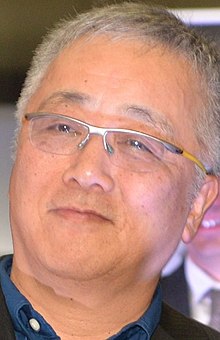 Otomo in 2016 | |
| Born | (1954-04-14) April 14, 1954 Miyagi Prefecture, Japan |
| Nationality | Japanese |
| Expanse(s) | Writer, Penciller |
| Notable works | Dōmu Akira Urban center Steamboy |
| Awards |
|
Katsuhiro Otomo ( 大友 克洋 , Ōtomo Katsuhiro , built-in April 14, 1954) is a Japanese manga creative person, screenwriter, animator and picture show managing director. He is best known as the creator of Akira, in terms of both the original 1982 manga series and the 1988 animated film accommodation. He was decorated a Chevalier of the French Ordre des Arts et des Lettres in 2005,[one] promoted to Officier of the order in 2014,[2] became the fourth manga artist ever inducted into the American Eisner Award Hall of Fame in 2012,[3] and was awarded the Purple Medal of Honour from the Japanese authorities in 2013.[4] Otomo later received the Winsor McCay Award at the 41st Annie Awards in 2014 and the 2015 Grand Prix de la ville d'Angoulême, the first manga creative person to receive the laurels.[5] [6] Otomo is married to Yoko Otomo. Together they take one child, a son named Shohei Otomo, who is also an artist.[7]
Early life [edit]
Katsuhiro Otomo was born in Tome, Miyagi Prefecture and grew up in Tome Commune. He said that living in the very rural Tōhoku region left him with nothing to exercise as a child, so he read a lot of manga.[8] As the merely boy in a family unit with older and younger sisters, he enjoyed reading and drawing manga on his ain and idea about becoming a manga artist. Limited by his parents to buying one manga volume a month, Otomo typically chose Kobunsha's Shōnen magazine, which included Astro Boy by Osamu Tezuka and Tetsujin 28-get by Mitsuteru Yokoyama, series which he would copy drawing in elementary schoolhouse. However, he said it was after reading Shotaro Ishinomori'south How to Draw Manga that he understood how to draw manga properly and started doing then more seriously.[eight]
While Otomo was in high schoolhouse, he became fascinated with movies and thought about condign an illustrator or film director. At this fourth dimension, one of his friends introduced him to an editor at Futabasha, who, after seeing Otomo's manga, told the high school pupil to contact him if he moved to Tokyo later on graduating. Otomo did exactly that, and began his career every bit a professional manga artist.[8]
Career [edit]
Manga [edit]
On Oct 4, 1973, Otomo published his first work, a manga adaptation of Prosper Mérimée'south short story Mateo Falcone, titled A Gun Written report.[9]
In 1979, afterwards writing multiple short-stories for the mag Weekly Manga Action, Otomo created his get-go science-fiction work, titled Fireball. Although the manga was never completed, it is regarded every bit a milestone in Otomo's career as information technology independent many of the aforementioned themes he would explore in his subsequently, more successful manga such equally Dōmu. Dōmu began serialization in Jan 1980 and ran until July 1981. It was not published in book form until 1983, when it won the Nihon SF Taisho Award.[10] It also won the 1984 Seiun Award for Best Comic.[11]
In a collaboration with writer Toshihiko Yahagi, Otomo illustrated Kibun wa mō Sensō near a fictional war that erupts in the border between Cathay and the Soviet Spousal relationship. It was published in Weekly Manga Action from 1980 to 1981 and collected into one book in 1982. Information technology won the 1982 Seiun Award for Best Comic.[11] 38 years later, the two created the ane-shot sequel Kibun wa mō Sensō iii (Datta Kamo Shirenai) for the April xvi, 2019 consequence of the mag.[12]
Also in 1981, Otomo drew A Farewell to Weapons for the Nov 16 result of Kodansha'south Young Magazine. It was later included in the 1990 short story drove Kanojo no Omoide....[thirteen]

Otomo posing on a replica of a futuristic motorcycle seen in his series Akira (2016)
In 1982, Otomo began what would get his nigh acclaimed and famous work: Akira. Kodansha had been asking him to write a serial for their new Immature Magazine for some fourth dimension, but he had been decorated with other work. From the first meeting with the publisher, Akira was to be only about ten chapters "or something similar that," and so Otomo said he was really not expecting information technology to exist a success.[8] It was serialized for 8 years and 2000 pages of artwork.
In 1990, Otomo did a cursory interview with MTV for a general segment on the Japanese manga scene at the time.[14] Otomo created the one-shot Hi no Yōjin near people who put out fires in Japan's Edo menstruum for the debut issue of Comic Cue in January 1995.[15]
Otomo wrote the 2001 picture volume Hipira: The Fiddling Vampire, which was illustrated by Shinji Kimura.[sixteen]
Otomo created the full-colour work DJ Teck no Morning Assault for the April 2012 outcome of Geijutsu Shincho.[17]
Following the 2011 Tōhoku convulsion and tsunami, Otomo, a native of the Tōhoku region, designed a relief that features a boy riding a robot goldfish in crude seas, while flanked past Fūjin and Raijin. Intended to capture the region's will to overcome the natural disaster, it has been located on the first floor of the terminal building at Sendai Airdrome since March 2015.[18]
In 2019, Kodansha announced that they will be re-releasing Otomo's unabridged trunk of manga since 1971 as part of "The Complete Works Project". It was noted that some of his manga were edited when initially compiled into book format, and this new project, personally overseen by Otomo, plans to restore them to how they appeared in their original serialization.[nineteen]
Otomo was initially reported in 2012 to be working on his commencement long-course manga since Akira.[20] Planning to draw the work that is fix during Japan's Meiji period without administration, he was initially targeting a younger audition, but said the story had developed more towards an older one. Although planned to begin in fall 2012, Otomo revealed in November of that year that the series had been delayed.[21] In 2018, Otomo said he is working on a full-length piece of work, but the contents are clandestine.[22]
Picture [edit]
At the age of 25, Otomo spent about 5 million yen to brand a 16 mm live-action film well-nigh an hour long. He said that making this private film showed him roughly how to make and direct movies.[eight] In 1982, Otomo made his anime debut, working as graphic symbol designer for the animated moving picture Harmagedon: Genma Wars. It was while working on this film that Otomo began to call back he could do it by himself.[8]
In 1987, Otomo directed an animated work for the beginning time: a segment, which he also wrote the screenplay and drew animation for, in the anthology feature Neo Tokyo. He followed this up with two segments in another album released that year, Robot Funfair. In 1988, he directed the animated motion picture adaptation of his manga Akira.
Otomo was executive producer of 1995's Memories, an anthology motion picture based on three of his stories. Additionally, he wrote the script for Stink Bomb and Cannon Fodder, the latter of which he likewise directed.[23]
Otomo has worked extensively with the studio Sunrise. In 1998, he directed the CG short Gundam: Mission to the Rise to celebrate the 20th anniversary of their Gundam franchise.[24] The studio has animated and produced his 2004 feature film Steamboy, 2006's Freedom Project, and 2007'south SOS! Tokyo Metro Explorers: The Next. The last, is based on Otomo's 1980 manga SOS! Tokyo Metro Explorer and follows the son of its main characters.[25]
The 2001 animated flick Metropolis features a script written by Otomo that adapts Tezuka's manga of the same name.[26]
Otomo directed the 2006 live-activeness flick Mushishi, based on Yuki Urushibara's manga of the same name.[27]
In 2013, Otomo took office in Short Peace, an anthology consisting on four brusque films; he directed Combustible, a tragic love story set in the Edo menses based on his 1995 manga Howdy no Yōjin,[15] while Hajime Katoki directed A Farewell to Weapons, depicting a battle in a ruined Tokyo based on Otomo'southward 1981 manga of the same proper noun.[13] Combustible won the 1000 Prize in the Animation category of the Nippon Media Arts Festival in 2012,[28] and was shortlisted for the 2013 All-time Animated Short at the 85th Academy Awards, merely failed to go nominated.
Otomo directed the music video for Aya Nakano'south 2016 song "Juku-Hatachi".[29] He is a fan of the singer and previously drew the cover to her 2014 album Warui Kuse.[29]
Reports take suggested that Otomo will be the executive producer of the live-action moving picture adaptation of Akira.[xxx] In 2019, he appear that he is writing and directing an animated film accommodation of his 2001 manga Orbital Era with Sunrise.[31]
Style [edit]
Otomo said that when he started his professional career in the late 1970s, "virtually all manga was gekiga like Golgo 13. Then it was all gekiga or sports manga, nothing to do with science fiction." Remembering how much he loved science fiction as a child, Otomo wanted to recreate that kind of excitement; "That was in office how something like Domu came almost. [...] There was no hard science fiction manga [...] then I wanted to change that and exercise something more realistic and believable."[viii]
Describing his characterization style, Otomo said he first tried to describe and imitate "very traditional manga-like fine art," such as Astro Male child. Simply by the time he was in loftier school, illustration work by people like Tadanori Yokoo and Yoshitaro Isaka was popular, so he wanted to create manga characters with this illustrative fine art manner.[8] When asked nearly how Japanese critics praise him as the beginning manga artist to draw realistic Japanese faces, Otomo said he always tries to balance fantasy and realism; "Depicting things besides realistically actually damages the social realism of the piece, and if you go besides far into the realm of fantasy, that hurts its imaginative ability." However, he said the realism of his early works probably came from having used friends equally character models.[32] French bande dessinée artist Moebius, who is known for realistic character designs, is ofttimes cited equally one of Otomo's biggest influences.[33]
Otomo includes homages to his favorite childhood manga in his work, and there were iii manga authors that he really respected; Osamu Tezuka, Shotaro Ishinomori and Mitsuteru Yokoyama. He named the main reckoner in Fireball ATOM after Tezuka'south graphic symbol of the same proper name, the character nicknamed Ecchan in Domu is a reference to Ishinomori's Sarutobi Ecchan, and the title character of Akira is also known as No. 28 in homage to Yokoyama'south Tetsujin 28-go in addition to the two series having the "same overall plot."[8] Ever since depicting the apartment complex in Domu, Otomo has had a large interest in architecture, proclaiming, "I don't call back at that place was anyone before me who put this much effort into their depictions of buildings." He believes this habit of cartoon detailed backgrounds was influenced by Shigeru Mizuki's manga, which showed him how important backdrops are to a story.[32] Otomo strongly praised the framing washed by Tetsuya Chiba, whose work he studied a lot out of adoration, for making it piece of cake to grasp how tangible the backgrounds and characters are.[34]
When asked about his influences in designing the mecha in Farewell to Weapons, Otomo pointed out that Studio Nue's work was popular at the time, specifically mentioning the powered conform designs by Kazutaka Miyatake and Naoyuki Kato. He as well stated that he is a fan of mecha by Takashi Watabe and Makoto Kobayashi and is fond of those seen in Neon Genesis Evangelion, but explained that all his influences are jumbled and mixed together; "In short, I digest many different things and ideas tend to pop out from that."[eight]
Legacy [edit]
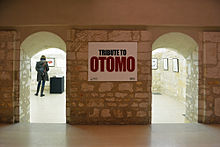
Information technology was effectually the 1979 publication of his Short Peace curt story collection that Otomo's work became influential in Nihon. Artists influenced by him and his piece of work include Hisashi Eguchi, Naoki Urasawa, Naoki Yamamoto, Makoto Aida and Hiroya Oku.[35] [36] [37] When talking in 1997 near the future of manga, Urasawa opined that "[Osamu] Tezuka created the form that exists today, so caricatures appeared next, and comics changed over again when Katsuhiro Otomo came on the scene. I don't recall there'southward any room left for further changes."[38] Masashi Kishimoto cited Otomo as 1 of his two biggest influences, but liked Otomo's art style the best and imitated information technology while trying to develop his own.[39]
Otomo's manga work also notably influenced a number of Japanese video game designers by the mid-1980s, including Enix'south Yuji Horii (The Portopia Serial Murder Case and Dragon Quest), Capcom's Noritaka Funamizu (Gun.Fume and Hyper Dyne Side Arms), UPL's Tsutomu Fujisawa (Ninja-Child), Thinking Rabbit's Hiroyuki Imabayashi (Sokoban), dB-SOFT's Naoto Shinada (Volguard), Hot-B's Jun Kuriyama (Psychic City), and Microcabin's Masashi Katou (Eiyuu Densetsu Saga).[xl]
Director Satoshi Kon, who worked equally an assistant to Otomo in both manga and motion-picture show, cited Akira and especially Domu as influences.[41] American film director Rian Johnson is a large fan of Otomo and pointed out similarities between how telekinesis is depicted in Domu and its depiction in his film Looper.[42]
In 2017, the volume Otomo: A Global Tribute to the Mind Behind Akira was published in Nihon, France and the Usa, featuring writing and artwork from 80 artists such equally Masakazu Katsura, Taiyo Matsumoto, Masamune Shirow, Asaf and Tomer Hanuka, and Stan Sakai.[43] From Apr 8 to May 8, 2021, comic art collector Phillipe Labaune's self-titled fine art gallery in New York Metropolis held "Proficient For Health, Bad For Pedagogy: A Tribute to Otomo" as its get-go exhibition.[44] Including pieces originally curated by Julien Brugeas for the 2016 Angoulême International Comics Festival, it featured a full of 29 Otomo-inspired works past international artists such as Sara Pichelli, Paul Pope, Boulet, François Boucq, Giannis Milonogiannis and Ian Bertram.[45]
Bibliography [edit]
Manga [edit]
| Year(s) | Title | Notes |
|---|---|---|
| 1973 | A Gun Report ( 銃声 ) | |
| 1977–1978 | Sayonara Nippon ( さよならにっぽん ) | |
| 1979 | Short Peace ( ショート・ピース ) | Short story collection published by Kisō Tengaisha. Reissued by Futabasha in 1984 equally the 3rd installment in the Katsuhiro Otomo Masterpiece Collection, with the addition of "Yume no Sōkyū" ( 夢の蒼穹 ). |
| 1979 | Fireball | |
| 1979–1980 | Ōtomo Katsuhiro no Eiyō Manten! 大友克洋の栄養満点! | |
| 1979 | Seija ga Machi ni Yattekuru 聖者が街にやってくる | |
| 1979 | Grand... | Written by Nobuyuki Shirayama |
| 1979–1983 | Manjū Kowai ( 饅頭こわい ) | |
| 1979 | Highway Star ( ハイウェイスター ) | First short story collection in the Katsuhiro Otomo Masterpiece Collection. |
| 1980–1981 | Dōmu ( 童夢 ) | |
| 1980–1981 | That's Astonishing World | |
| 1980–1981 | Kibun wa mō Sensō ( 気分はもう戦争 ) | Written past Toshihiko Yahagi |
| 1980–1981 | Apple Paradise | Unfinished |
| 1981 | Sayonara Nippon | Second short story collection in the Katsuhiro Otomo Masterpiece Drove. |
| 1981 | Hansel & Gretel ( ヘンゼルとグレーテル ) | Short story collection |
| 1982–1990 | Akira | |
| 1984 | Visitors | |
| 1990 | Kanojo no Omoide... ( 彼女の想いで… ) | Short story drove |
| 1990 | The Legend of Female parent Sarah | Illustrated past Takumi Nagayasu |
| 1995 | Hi no Yōjin ( 火之要鎮 ) | |
| 1996 | SOS! Tokyo Metro Explorers ( SOS大東京探検隊 ) | Brusk story collection |
| 1996 | Batman: Black & White #4 (The Third Mask) | Writer, Penciller |
| 2001 | Hipira: The Fiddling Vampire ( ヒピラくん ) | Illustrated by Shinji Kimura |
| 2001 | Orbital Era | |
| 2006 | Park ( 公園 ) | |
| 2012 | DJ Teck no Morning Attack DJ TECK の Morning time Assault | |
| 2012 | Kibun wa mō Sensō three (Datta Kamo Shirenai) 気分はもう戦争3(だったかも知れない) | Written by Toshihiko Yahagi |
Artbooks [edit]
| Year | Title | Notes |
|---|---|---|
| 1989 | Kaba | |
| 1995 | Akira Guild | |
| 2003 | Akira Animation Archives | |
| 2008 | Viva il Ciclissimo! | Collaboration with Katsuya Terada |
| 2012 | Kaba 2 | |
| 2012 | Genga |
Filmography [edit]
Director [edit]
| Year | Title | Notes |
|---|---|---|
| 1982 | Jiyū wo Warera ni ( じゆうを我等に ) | Alive-action |
| 1987 | Neo Tokyo | Segment: "Construction Cancellation Order" |
| 1987 | Robot Carnival | Segments: "Opening" and "Ending" |
| 1988 | Akira | |
| 1991 | Earth Apartment Horror | Live-action |
| 1995 | Memories | Segment: "Cannon Fodder" |
| 1998 | Gundam: Mission to the Rise | Short film |
| 2004 | Steamboy | |
| 2006 | Mushishi | Live-action |
| 2013 | Brusque Peace | Segment: "Combustible" |
| 2016 | Juku-Hatachi ( じゅうくはたち ) | Music video for Aya Nakano |
| TBA | Orbital Era |
Screenwriter [edit]
| Year | Title | Notes | |||||||||||||||
|---|---|---|---|---|---|---|---|---|---|---|---|---|---|---|---|---|---|
| 1987 | Neo Tokyo | Segment: "Construction Counterfoil Order" | |||||||||||||||
| 1987 | Robot Carnival | Segments: "Opening" and "Catastrophe" | |||||||||||||||
| 1988 | Akira | ||||||||||||||||
| 1991 | Roujin Z | ||||||||||||||||
| 1995 | Memories | Segments: "Cannon Provender" and "Stink Bomb" | 1997 | ETO rangers the movie (knocking on mugen's door) | align="centre" | 2001 | Urban center | |||||||||||
| 2004 | Steamboy | ||||||||||||||||
| 2006 | Mushishi | Live-action | |||||||||||||||
| 2013 | Short Peace | Segment: "Combustible" | |||||||||||||||
| TBA | Orbital Era |
Additional work [edit]
Besides his own animation, Otomo has contributed art designs to Harmagedon: Genma Wars,[46] the Crusher Joe film,[47] the seven-role OVA series Freedom Project, and Infinite Dandy episode 22. He likewise oversaw the composition of the Spriggan animated film.[48]
Notes [edit]
- ^ "Katsuhiro Otomo Receives Nippon Medal with Regal Ribbon". Anime News Network. Nov 1, 2013. Retrieved Nov 1, 2013.
- ^ "Akira'due south Katsuhiro Otomo Announces Live-Action Film Plans". Anime News Network. December 14, 2014. Retrieved December 14, 2014.
- ^ "ANIME NEWS: Katsuhiro Otomo inducted into Eisner's Hall of Fame". Asahi Shimbun. August 14, 2012. Archived from the original on October 17, 2013. Retrieved Oct xvi, 2013.
- ^ "ANIME NEWS: 'Akira' creator Katsuhiro Otomo honored by regime". Asahi Shimbun. November thirteen, 2013. Archived from the original on November 16, 2013. Retrieved November 27, 2013.
- ^ "Annie Awards to honor animator Katsuhiro Otomo for career achievement". Los Angeles Times. January 31, 2014.
- ^ "Japan's Otomo first manga artist to win top French prize".
- ^ Bailey, John (November 21, 2017). "Tattooed sumo stars as artist Shohei Otomo brings his ballpoints to Melbourne". The Sydney Morning Herald . Retrieved March xiv, 2019.
- ^ a b c d east f g h i j "Katsuhiro Otomo On Creating 'Akira' And Designing The Coolest Bike In All Of Manga And Anime". Forbes. May 26, 2017. Retrieved September 4, 2021.
- ^ Brooks, Brad; Tim Pilcher (2005). The Essential Guide to Globe Comics. London: Collins & Chocolate-brown. p. 103. ISBN1-84340-300-five.
- ^ "Nihon SF Taisho Award Winners Listing". Scientific discipline Fiction Writers of Japan. Archived from the original on September 19, 2020. Retrieved Jan 28, 2010.
- ^ a b "星雲賞リスト". Nihon SF Taikai (in Japanese). Retrieved October xv, 2021.
- ^ "Akira's Katsuhiro Otomo Draws New Kibun wa mō Sensō ane-Shot After 38 Years". Anime News Network. April 12, 2019. Retrieved September 6, 2021.
- ^ a b "Katsuhiro Otomo Draws New Embrace for His "A Cheerio to Arms" Manga". Crunchyroll. November 5, 2013. Retrieved September 6, 2021.
- ^ MTV spotlights Japanese comics (1990), archived from the original on December 11, 2021, retrieved Nov eighteen, 2019
- ^ a b "Akira's Otomo Makes "Hi no Yōjin/Flammable" Anime Curt". Anime News Network. March ten, 2012. Retrieved September half dozen, 2021.
- ^ "Otomo's Hipira: The Little Vampire Volume Gets TV Anime". Anime News Network. Dec 10, 2009. Retrieved September half-dozen, 2021.
- ^ "Creator of "Akira" Reveals New Shonen Manga Serialization Plans". Crunchyroll. March 25, 2012. Retrieved September 6, 2021.
- ^ "Behemothic 'recovery' artwork by 'Akira' creator Otomo unveiled for public". The Asahi Shimbun. Feb iv, 2015. Archived from the original on July vii, 2015. Retrieved September 6, 2021.
- ^ "Kodansha to Launch 'The Consummate Works Project' for Katsuhiro Otomo". Anime News Network. July 4, 2019. Retrieved September four, 2021.
- ^ "Akira'due south Katsuhiro Otomo Working on New Manga". Otaku USA. March 26, 2012. Retrieved Nov 18, 2019.
- ^ "Akira's Otomo Delays New Manga Series". Anime News Network. November 5, 2012. Retrieved September 4, 2021.
- ^ "Akira Creator Katsuhiro Otomo Continues Work on New Full-Length Manga". Anime News Network. November 13, 2018. Retrieved September 4, 2021.
- ^ "Australia'southward Siren Visual to Release Otomo's Memories Blu-ray". Anime News Network. November two, 2014. Retrieved September half-dozen, 2021.
- ^ "Gundam 40th Anniversary Promotional Anime Teased for This Winter". Anime News Network. September 26, 2019. Retrieved September six, 2021.
- ^ "SOS! Tokyo Metro Explorers Website, Trailer Launched". Anime News Network. November 14, 2007. Retrieved September half-dozen, 2021.
- ^ "New movie from Katsuhiro Otomo and Rin Taro". Anime News Network. July 29, 2000. Retrieved September 6, 2021.
- ^ "Akira's Katsuhiro Otomo Announces Live-Action Film Plans". Anime News Network. December 14, 2014. Retrieved September half-dozen, 2021.
- ^ Shimbun, The Yomiuri. "The Japan News". The Japan News . Retrieved November 18, 2019.
- ^ a b "大友克洋が初めて実写MVの監督に、なかの綾のアルバム曲で". Natalie. June 14, 2016. Retrieved September 27, 2021.
- ^ "Live action Akira moving-picture show coming, DiCaprio and Otomo signed on to produce". Autoblog . Retrieved Nov 18, 2019.
- ^ "Akira'due south Katsuhiro Otomo Reveals Orbital Era Film With Sunrise". Anime News Network. July 4, 2019. Retrieved September 6, 2021.
- ^ a b "x Years of Kodansha Comics—January Spotlight: AKIRA". Kodansha. January 9, 2019. Retrieved September 4, 2021.
- ^ Lee, Andrew (May 17, 2012). "Otomo'due south genga will make you retrieve". The Japan Times . Retrieved September 24, 2021.
- ^ "Akira Creator Katsuhiro Otomo Cites Ashita no Joe Creator equally Influence". Anime News Network. November 18, 2018. Retrieved September 4, 2021.
- ^ "Hisashi Eguchi: "Beautiful girls take a period of being really invincible."". Sex Magazine. 2013. Retrieved September 4, 2021.
- ^ "大友克洋特集がAERAで、浦沢直樹や山本直樹らが影響語る" (in Japanese). Natalie. Baronial 13, 2013. Retrieved Jan 30, 2021.
- ^ "奥浩哉の「いぬやしき」特集、山本直樹×奥浩哉の師弟対談" (in Japanese). Natalie. January xiv, 2014. Retrieved Oct 22, 2021.
- ^ "The Birth of Best Seller Comics Writers of the New Generation of Comics and their World No. 3: "YAWARA!"". Shogakukan. Dec half dozen, 1998. Archived from the original on December 6, 1998.
- ^ Kishimoto, Masashi (2006) [2001]. Naruto. Vol. 10. Viz Media. p. 157. ISBN978-one-4215-0240-3.
- ^ "59 Developers, 20 Questions: 1985 Interview Special". Beep. October 1985. Archived from the original on Jan 7, 2017. Retrieved February 22, 2017.
- ^ "Interview with Satoshi Kon, Director of Perfect Blue". Perfect Blue official website. September 4, 1998. Archived from the original on April 2, 2012. Retrieved September 4, 2021.
- ^ "Roundtable Interview with Rian Johnson on Looper". We Got This Covered. September 27, 2012. Retrieved September 4, 2021.
- ^ "80 Artists & Writers Contribute to Katsuhiro Otomo Tribute Book". Anime News Network. Dec xix, 2016. Retrieved September 5, 2021.
- ^ "Phillipe Labaune Comic Art Gallery Opens In New York With "Good For Wellness, Bad For Education: A Tribute to Otomo"". Crunchyroll. April 16, 2021. Retrieved September 5, 2021.
- ^ "Good for Health - Bad for Education: A Tribute to Otomo". philippelabaune.com . Retrieved September 5, 2021.
- ^ "Cached Garbage - Harmagedon". Anime News Network. January eight, 2009. Retrieved September 6, 2021.
- ^ "Haruka Takachiho Planned Crusher Joe 2 Picture with Katsuhiro Otomo, but Never Happened". Crunchyroll. April half-dozen, 2021. Retrieved September 6, 2021.
- ^ "SPRIGGAN". Studio iv°C . Retrieved September half-dozen, 2021.
References [edit]
- "Liberty". (May 2007) Newtype USA. p. 23.
External links [edit]
- Otomo: The Complete Works
- Katsuhiro Ôtomo at IMDb
- Katsuhiro Otomo at Anime News Network'due south encyclopedia
- Katsuhiro Ôtomo at The Encyclopedia of Science Fiction
stevenshimbeyer1942.blogspot.com
Source: https://en.wikipedia.org/wiki/Katsuhiro_Otomo

Post a Comment for "Becoming a Child Again Doujinshi Artist Cg"